
Buying an NVIDIA DGX Station can be complicated because there are multiple DGX Station GB300 configurations and options for purchasing the core NVIDIA platform, which is sold through several OEMs, including ASUS, Dell, Gigabyte, HP, MSI, Supermicro and Exxact.
They share the same NVIDIA GB300 Grace Blackwell Ultra platform, but differ in storage, chassis, cooling, support, additional GPUs, price, and availability.
The good news is that choosing between them is much simpler once you understand what is shared and what actually changes.
This guide covers:
- The DGX Station models available in 2026.
- The differences between them.
- What workloads a DGX Station can realistically run.
- When DGX Spark may make more sense.
- DGX Station prices and available discounts.
- How and where to buy a DGX Station.
For a broader introduction to the platform, see our NVIDIA DGX Station overview.
The different NVIDIA DGX Station models at a glance
ASUS, Dell, HP, MSI, Supermicro and the other OEMs use the same NVIDIA GB300 Grace Blackwell Ultra Desktop Superchip.
In each model, there is:
- NVIDIA Blackwell Ultra GPU.
- NVIDIA Grace 72-core Arm CPU.
- 748 GB coherent memory.
- 252 GB HBM3e GPU memory.
- 496 GB LPDDR5X CPU memory.
- 7.1 TB/s HBM3e memory bandwidth.
- Up to 20 PFLOPS FP4 AI performance.
- ConnectX-8 networking with up to 800 Gb/s.
- Multi-Instance GPU support for up to seven isolated workloads.
Tip: Do not choose an OEM expecting one GB300 system to deliver radically higher core AI performance than another.
The specs above are the same for each model, and differences between models are the platform packages, e.g., the amount of storage they come with, cooling, chassis mounting, and other features like separate graphics cards.
Below, we give you a short introduction to each DGX Station model and what each is best for.
Top Choice: HP ZGX Fury G1n AI Station (NVIDIA DGX Station GB300)
The HP ZGX Fury is, in our opinion, the best DGX Station option for most buyers right now.
It offers fantastic value with included HP ZGX Toolkit / HP ZU Runtime CLI software (this allows you to link two HP DGX Stations effortlessly and quickly pull and deploy Hugging Face models, MLflow tracking and Ollama testing) and rack-mount rails for rack configuration.

Our current HP ZGX Fury configuration combines four 2 TB drives with an RTX PRO 2000 Blackwell and three years of onsite service.
Pi3g is an official business partner of HP, reseller of the HP ZGX Fury G1n AI Station and other HP AI Solutions. That means we can offer best-in-market delivery times compared with several other DGX Station models.
Learn more about Pi3g’s HP ZGX Fury offers and get the latest pricing.
At the time of writing this buyer’s guide, this DGX Station model can be purchased for €109,243.70 excluding VAT from BuyZero.
The HP DGX Station configuration makes sense for organisations that want GB300 AI compute, a separate graphics GPU, strong OEM support and relatively quick availability.
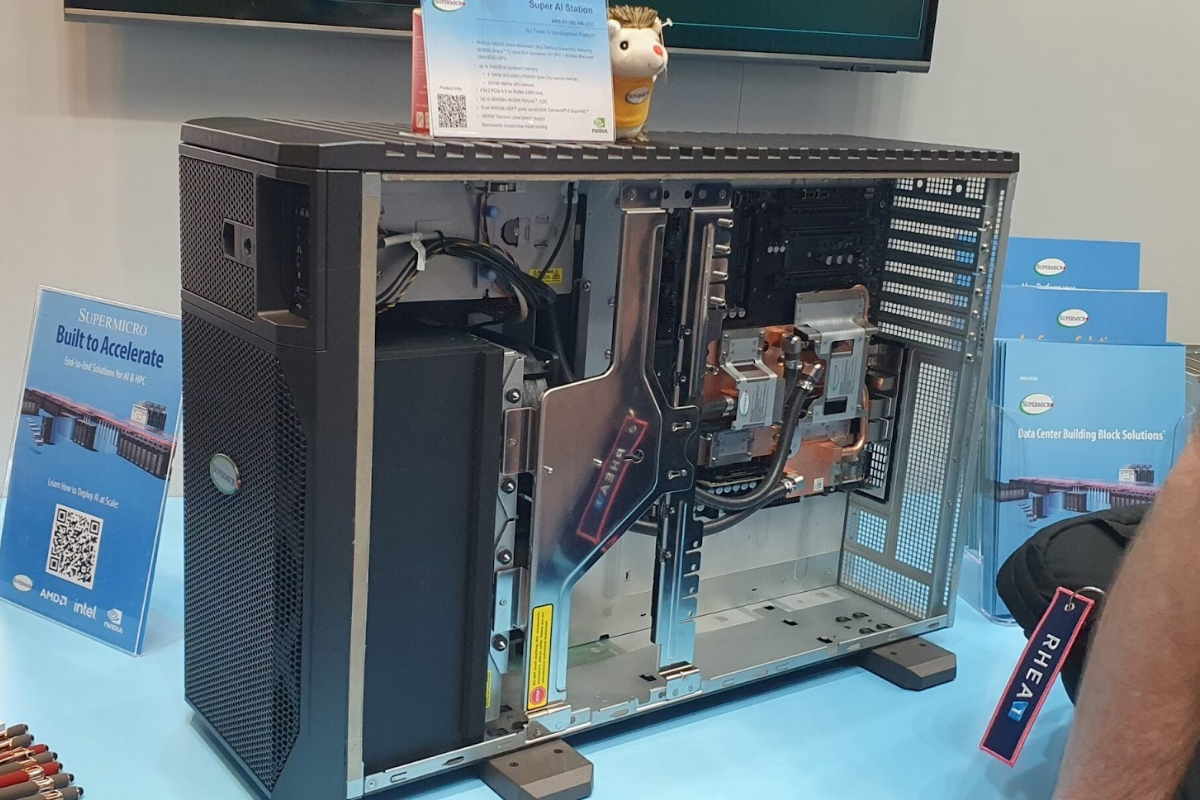
Supermicro Super AI Station ARS-511GD-NB-LCC

Photo: Supermicro Super AI Station ARS-511GD-NB-LCC taken by Pi3g.
The Supermicro system is one of the most straightforward implementations of the DGX Station platform and sits toward the lower end of current pricing.
Its current configuration includes two 1 TB and two 2 TB M.2 SSDs. Physically, Supermicro uses a 5U tower chassis with a closed-loop liquid cooling system that can be serviced.
We have inspected the inside of this machine in person, including its cooling system, motherboard layout and expansion capacity. If your priority is getting the core GB300 platform at one of the lowest available prices, Supermicro is a good option.
See our Supermicro ARS-511GD-NB-LCC teardown and specifications. Or order a Supermicro Super AI Station ARS-511GD-NB-LCC directly from us today.
MSI XpertStation WS300
MSI's XpertStation WS300 is another relatively low-cost route into DGX Station.
The current configuration has two 2 TB M.2 drives. Core GB300 performance is the same as the other systems.
For buyers mainly interested in AI development, inference and fine-tuning rather than large amounts of internal storage or premium support packages, the MSI configuration provides less storage but is a lower-cost option.
Exxact Valence and TensorEX
Exxact offers several DGX Station configurations based on platforms from other OEMs.
One current Valence configuration includes an RTX PRO 2000 Blackwell alongside the GB300 platform. This is useful where the machine needs stronger conventional graphics, display or visualisation capabilities alongside its main AI workload.
Exxact’s DGX Station models are ideal for when you want more choice around configuration rather than simply buying the base OEM system.
Gigabyte W775-V10-L01
Gigabyte currently offers the W775 with four 2 TB M.2 drives, giving it 8 TB of storage in the configuration we offer.
It retains the same 748 GB coherent memory and GB300 compute platform.
For teams expecting to keep large model libraries, datasets and local AI projects on the machine, the extra storage on this model can make it more attractive than the lower-cost base configurations.
ASUS ExpertCenter Pro ET900N G3
The ASUS ExpertCenter Pro ET900N G3 currently comes with four 2 TB M.2 drives and three years of onsite service.
That makes ASUS interesting for businesses that place more value on vendor support and a ready-to-use enterprise configuration than on finding the lowest purchase price.
Dell Pro Max with GB300
The Dell Pro Max currently sits at the premium end of the range.
Our current configuration includes four 4 TB M.2 drives, an RTX PRO 2000 Blackwell and three years of onsite service.
That gives it substantially more local storage than most of the lower-priced configurations.
Dell is best viewed as the premium preconfigured option for organisations where storage, support and delivery speed matter more than minimising the initial hardware price.
What can you run on a DGX Station?
This is where the DGX Station becomes much more unusual than a conventional AI workstation. Its 748 GB coherent memory pool lets you work with models that would normally require multiple discrete GPUs or server infrastructure.
NVIDIA rates the platform for inference with models of up to the 1 trillion parameter class, depending on model architecture and quantisation.
DGX Station performance reported by Pi3g
| Model | DGX Station performance |
|---|---|
| Kimi 2.5, 1.1T | Around 40 to 50 tokens/sec |
| Nemotron Ultra, 550B | Around 35 tokens/sec for a single request |
| GLM-5.2-REAP, 504B | Around 60 tokens/sec |
See our full GB300 specifications and LLM benchmark analysis.
The DGX Station has two memory tiers. The first is 252 GB of HBM3e running at 7.1 TB/s, which is the extremely fast memory attached to the Blackwell Ultra GPU. The second is 496 GB LPDDR5X memory, connected through NVLink-C2C.
Together they create a 748 GB coherent memory pool.
A quantised model that fits entirely within the 252 GB HBM3e tier can take full advantage of its high memory bandwidth.
Larger models can extend into the LPDDR5X using the full 748 GB pool. They still fit and run, but the sections outside HBM3e do not have the same memory bandwidth.
What is the DGX Station good for?
For most of the buyers that we speak to, the strongest DGX Station use cases are:
- Large-model local inference.
- Mixture-of-Experts models.
- Private enterprise AI.
- RAG systems using sensitive corporate data.
- AI agents.
- Model development.
- LoRA and QLoRA fine-tuning.
- Scientific AI.
- BioNeMo workloads.
- Shared AI infrastructure for development teams.
- Testing models before deploying them to larger data-centre infrastructure.
MIG can partition the GPU into up to seven isolated instances, allowing a DGX Station to serve as shared local AI infrastructure for multiple team members.
What can a DGX Station not do?
A DGX Station is extremely powerful for a deskside system, but it is not a replacement for every type of GPU infrastructure. For example, it is not designed to replace a large GPU cluster for training a frontier foundation model from scratch.
It is not the right architecture for every large-scale production inference service, either. A service handling very high numbers of simultaneous users may still be better suited to scalable server or cloud infrastructure.
The other limitation is memory speed once very large workloads spill beyond the 252 GB HBM3e tier.
The DGX Station solves a major problem by letting these models run locally in the first place. However, as we’ve already explained, it does not make all 748 GB of memory operate at HBM3e bandwidth.
For many enterprise AI teams, that trade-off is far preferable to splitting a model manually across several discrete GPUs.
A DGX Station is also not ideal for gaming. There are far more cost-effective options for that.
Can you connect multiple DGX Stations?
Yes, and this is a common customer use case.
Each DGX Station includes an NVIDIA ConnectX-8 SuperNIC with two 400 Gb/s ports. Two DGX Stations can be linked for workloads that can scale across multiple systems, increasing the compute and memory resources available.
This creates an interesting upgrade path.
Pi3g’s enterprise customers often order multiple stations. However, many begin with one Station, validate its workloads, and later add another rather than immediately deploying a larger server platform.
For very large deployments, rack-scale NVIDIA systems remain the more appropriate architecture.
Do you need a DGX Station, or would DGX Spark be enough?
Here, we want to address a common customer question: what size station do I need?
The DGX Spark is a much smaller and cheaper method for running LLMs locally.
A Spark offers:
- Up to 128 GB unified memory (a 64 GB model is available, too).
- Up to 1 PFLOP FP4 AI performance.
- Support for models up to around 200 billion parameters.
- A compact desktop form factor.
- Much lower power requirements.
That said, the Spark is also an order of magnitude less powerful than the DGX Station, which offers:
- 748 GB coherent memory.
- 252 GB HBM3e.
- Up to 20 PFLOPS FP4.
- Up to 1 trillion parameter model support.
- Enterprise management features.
- MIG.
- Much faster networking.
- Greater expansion capacity.
For a developer experimenting with local models, smaller RAG applications or agentic systems, DGX Spark may be all the hardware you need. Many of our Spark customers include small companies and private individuals.
For a team working with very large models, demanding local inference, large-scale RAG, heavier fine-tuning or shared AI infrastructure, DGX Station is in a different class. We have also sold DGX Stations to private individuals.
Read our full DGX Spark vs DGX Station comparison.
How much does an NVIDIA DGX Station cost?
As of October 2026, our current configurations of the DGX Station range from roughly €90,000 to €171,500 excluding VAT, depending on manufacturer and configuration.
At the lower end, you have systems such as Supermicro and MSI.
Prices increase as manufacturers add:
- More NVMe storage.
- RTX PRO graphics GPUs.
- Longer onsite support.
- Different chassis designs.
- Enterprise service packages.
For example, our current Supermicro configuration sits around €90,000 excluding VAT. A highly configured Dell Pro Max with 16 TB of storage, an RTX PRO 2000 and onsite support costs considerably more.
This price difference does not mean the Dell GB300 itself has almost twice the AI compute performance. The underlying GB300 platform remains the same, and thus the performance is effectively the same.
For current pricing and lead times, see our DGX Station availability and pricing page.
Can you get a discount on a DGX Station?
Yes. There are several routes to discounts.
The core one is the NVIDIA Inception discount. Eligible startups can apply through the NVIDIA Inception program.
The discount is substantial and currently above 5% of the purchase price. The program has eligibility requirements, and hardware purchased through the benefit is intended for the startup's own development, testing, evaluation and proof-of-concept use.
Pi3g can help customers apply for the discount and have it reflected in their quotation.
Read our guide to the NVIDIA Inception DGX Station discount.
NVIDIA Education discount
Qualified universities, research institutes and other education organisations may qualify for NVIDIA education pricing.
Pi3g can submit the required organisation’s information through the distribution and manufacturer process and provide a quote with the approved discount applied.
We offer project pricing for purchases of multiple DGX Stations too. Read our DGX Station education discount guide.
Where can you buy an NVIDIA DGX Station?
DGX Station purchasing works differently from buying a GeForce GPU or consumer NVIDIA product.
The GB300 DGX Station platform is built and sold through OEM partners such as:
- ASUS.
- Dell.
- Gigabyte.
- HP.
- MSI.
- Supermicro.
- Exxact.
Pi3g also sells DGX Station systems across the available OEM range and can help compare configurations before you commit.
Contact Pi3g about buying an NVIDIA DGX Station, and we can advise you directly about:
- Which DGX Station model fits your workload.
- Model and memory requirements.
- Storage configuration.
- Additional GPU requirements.
- Multi-station deployments.
- NVIDIA Inception discounts.
- Education discounts.
- Lead times.
- Custom AI software and deployment.
If you already know the models and workloads you plan to run, send them to us, and we can help determine whether you need a DGX Station, which configuration makes sense, or whether a smaller system such as DGX Spark would be sufficient.
Customers choose Pi3g as a DGX Station retailer due to best-in-class service.